SafeScroll
🧑 Adults · Parents & Carers
✂️ Cut-Out Cards
Self-Regulation Toolkit
Cut-Out Cards
Eight evidence-based strategies for managing device impulses — adapted from behavioural psychology for everyday family life. Print, cut, and keep in your wallet or on your desk.
Behavioural Psychology
CBT Techniques
NHS Wellbeing
How these cards work: Each card targets a specific moment when device impulses are hardest to resist. The strategies are drawn from Cognitive Behavioural Therapy, habit science, and mindfulness — simplified into actions you can take in under 2 minutes. You do not need to use all eight. Pick the two or three that match your own patterns.
How to use this toolkit
1
Print this page on card stock if possible
2
Cut out the cards you find most relevant
3
Keep 2–3 in your wallet, bag, or pinned at your desk
4
Read the card when you feel the urge — before you pick up the phone
✂️ Cut along the dashed lines — 8 cards total
✂Cut here
01
Technique · Urge surfing
Ride the wave
Use when
You feel a sudden urge to check your phone with no specific reason
Do this instead
›Notice the urge without acting on it. Name it: "I want to check my phone."
›Set a 5-minute timer. The urge will peak and pass — like a wave.
›After 5 minutes, decide intentionally if you still want to check.
The urge to check peaks within 2–3 minutes and then drops — waiting it out works 70% of the time (BPS, 2022)
02
Technique · Implementation intention
If–then planning
Use when
You want to break a specific habit loop (e.g. phone at dinner, scrolling before bed)
Write your if–then statement
›"If [trigger situation], then I will [specific alternative action]."
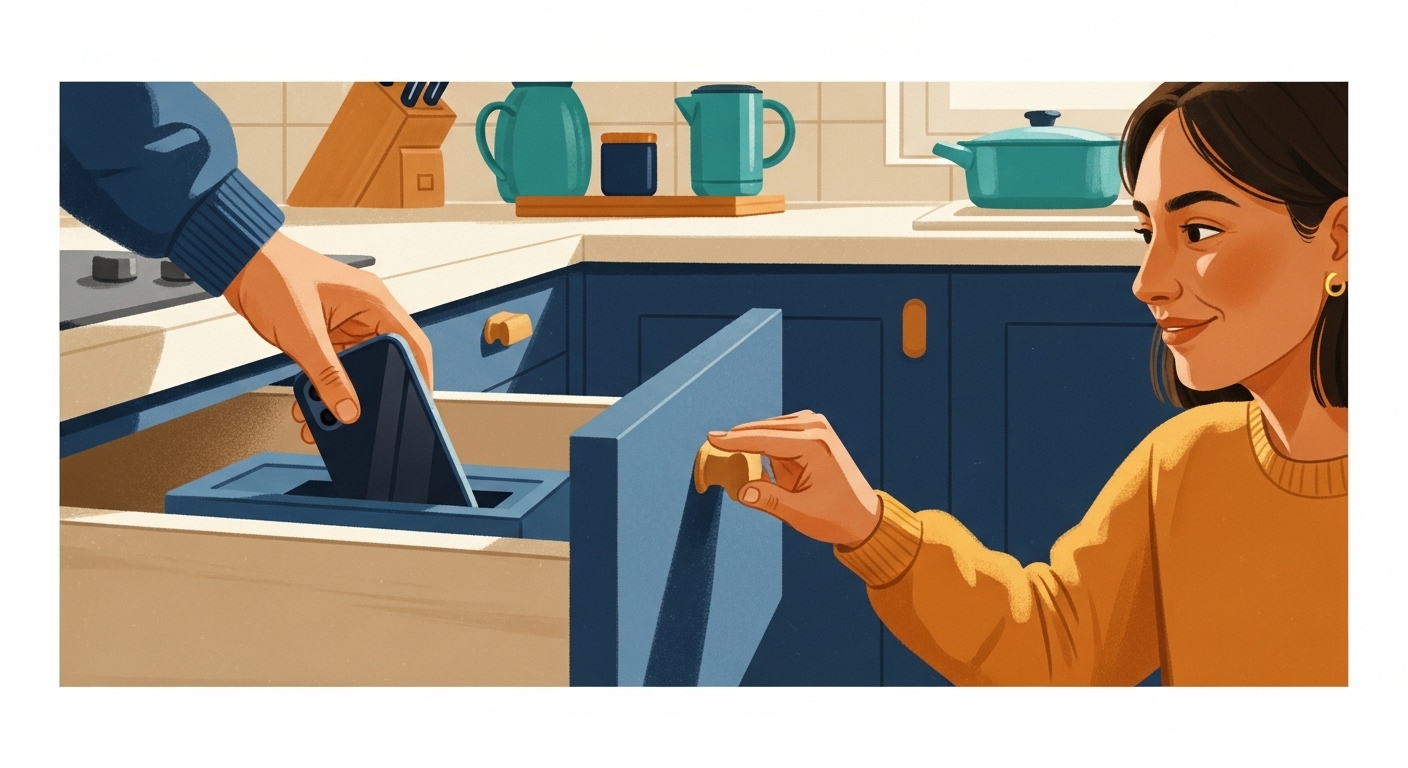
›Example: "If I sit down for dinner, then I will put my phone in the kitchen drawer."
›Write your version on the back of this card.
If–then planning increases follow-through on intentions by up to 3× compared to willpower alone (Gollwitzer, 1999)
✂Cut here
03
Technique · Friction increase
Add friction
Use when
You pick up your phone automatically, especially for social media apps
Do this instead
›Delete your most-used social apps from your home screen.
›Access them via browser only — the extra steps interrupt the automatic reach.
›Put your phone face-down, in a bag, or in another room during focus time.
Removing apps from the home screen reduces usage by 20–40% without blocking access (Duke et al., 2018)
04
Technique · Mindful pause
STOP before you scroll
Use when
You are about to open a social media app without a clear reason
The STOP method
›Stop — physically pause before opening the app.
›Take a breath — one slow, deliberate breath.
›Observe — what are you actually feeling right now?
›Proceed — open the app with intention, or put the phone down.
Mindful awareness of triggers before acting reduces automatic behaviour by interrupting the habit loop (Clear, 2018)
✂Cut here
05
Technique · Competing response
Replace the reach
Use when
You use your phone as a default response to boredom, waiting, or discomfort
Keep a list of 3-minute alternatives
›Write 3 things on the back of this card that take 1–3 minutes and don't require a screen.
›Do one of these when you feel the urge. They don't have to be productive — just non-screen.
›Examples: stretch, look out the window, make a drink, write a sentence in a notebook.
Competing responses need only be minimally incompatible with the habit to be effective (Lally et al., 2010)
06
Technique · Time boxing
Scheduled check-ins
Use when
You check your phone constantly throughout the day and want to regain a sense of control
Do this instead
›Decide on 3 fixed times per day to check social media and messages (e.g. 9am, 1pm, 6pm).
›Between those times, notifications stay off.
›Start with 2-hour gaps and extend as it becomes comfortable.
Checking email/messages on a schedule reduces stress and improves focus compared to always-on access (Kushlev & Dunn, 2015)
✂Cut here
07
Technique · Self-compassion reframe
You're not failing — you're rewiring
Use when
You have picked up your phone despite intending not to, and feel like giving up
Remember this
›These apps were designed by some of the world's best engineers to be hard to put down. The difficulty is real, not a character flaw.
›Habit change takes 66 days on average — not 7. One slip means nothing.
›Notice what happened, note the trigger, and move on without self-judgement.
Self-criticism after a lapse increases the likelihood of giving up entirely — self-compassion predicts better long-term habit outcomes (Neff, 2011)
08
Technique · Values clarification
The modelling question
Use when
You need a quick reminder of why you are working on your own screen habits
Ask yourself
›"If my child could see exactly how I use my phone right now, would I be comfortable with what they see?"
›"What kind of relationship with technology do I want to model for them over the next 10 years?"
›You don't need to answer aloud. Just let the question land.
Parental device habits are the strongest environmental predictor of children's screen use patterns (Ofcom, 2023; Lauricella et al., 2015)
✂End of cards
Want the complete adult digital wellness guide?
Our Adult Digital Wellness Guide pairs these cards with a 4-week reset programme, a screen habit tracker, and a full framework for modelling healthy habits for your children.